COP30 Becomes a Crucial Platform for Pacific Island Nations Facing Rising Seas
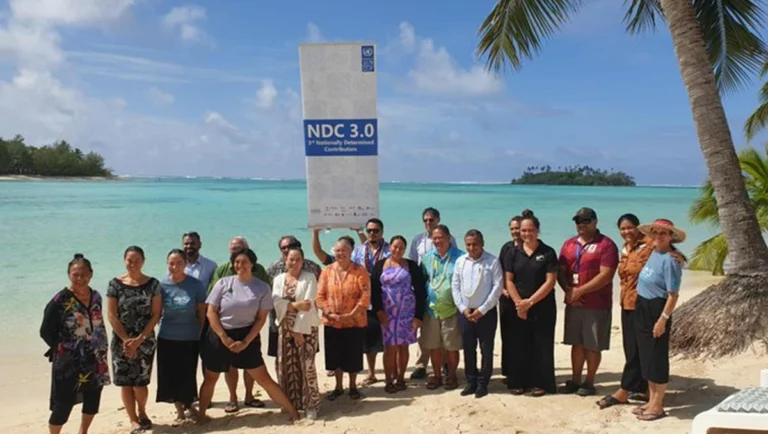
Cook Islands residents send a message to COP30 attendees, Nov. 2025. X/ @kanniwignaraja
November 12, 2025 Hour: 8:23 am
🔗 Comparte este artículo
The survival of Small Island States depends on global decisions on adaptation and funding.
The United Nations Climate Change Conference (COP30) this week in Belem, Brazil, is emerging as a crucial platform for the small island states of the Pacific, whose territories, ways of life, and even survival are threatened by the advance of climate change.
RELATED:
California Gov. Newsom Slams U.S. Absence at COP30
The political decisions, financing pledges, and frameworks for adaptation, loss and damage under discussion at the summit could mean the difference between territorial survival and the need to abandon entire islands or accept costly coexistence measures.
The nations at the center of this drama — Tuvalu, Kiribati, the Marshall Islands, and other Pacific atolls — are already experiencing the symptoms: more frequent coastal flooding, saltwater intrusion that ruins aquifers and farmland, accelerated erosion, and extreme weather events that destroy infrastructure and homes.
NASA research warned in 2024 that in the coming decades these places will face sea-level rise that will remain inevitable even if emissions are reduced, with estimates ranging from several centimeters to several dozen centimeters in the short term, further worsening the threats to habitability.
The Intergovernmental Panel on Climate Change (IPCC) has highlighted in its reports the particular vulnerability of low-lying territories. Coral atolls and small islands are especially susceptible to changes in average sea level and regional variations in waves and storms, with direct implications for the physical continuity of communities.
In Tuvalu, with an average elevation of just 2 meters (6.5 feet) above sea level, the ocean has risen by about 15 centimeters (6 inches) over the past three decades — roughly 1.5 times the global average — putting the habitability of its main atoll, Funafuti, at serious risk by 2050.
In Kiribati, most of its 33 islands lie less than 2 meters above sea level and already suffer frequent flooding, saltwater intrusion into aquifers, and increasing damage to homes and agriculture.
The 2025 report from the Kiribati Bureau of Statistics noted that one in four families had been affected by natural disasters. In the Marshall Islands, a World Bank study estimated that 40% of buildings would be at risk and that 96% of the capital could experience frequent flooding if current sea-level trends continue.
A Triple Threat
Scientific projections reinforce the urgency of reaching agreements that include funding for adaptation, coastal protection measures, and mechanisms for compensation for irreversible damage.
The World Meteorological Organization (WMO) also warns of a “triple threat”: sea-level rise, ocean warming, and acidification — a combination that amplifies ecological and socioeconomic risks across the region.
Politically, the presence and diplomatic weight of Pacific countries have grown at recent COPs; they are seeking not only financial compensation but also a global commitment to limit warming to 1.5 degrees Celsius and to accelerate emissions reductions.
At the same time, neighboring countries with historical responsibility for emissions and economic capacity, such as Australia, have moved to support the Pacific’s voice.
Canberra has formalized an ambitious proposal: to present a bid to host COP31 in 2026 in partnership with Pacific nations — a move that, if successful, would place the region at the center of the global climate debate and could facilitate more direct lines of support.
The diplomatic negotiations in Belem will offer indicators of whether the international community is willing to back, with resources and ambitious commitments, those who suffer most from a crisis they did not cause to the same extent.
teleSUR/ JF
Source: EFE